The Hammer Marks That Give Raised Silver Its Shape
Learn how raising silver turns flat sheet into a hollow form, and read the hammer marks that show where metal moved and how the maker worked.
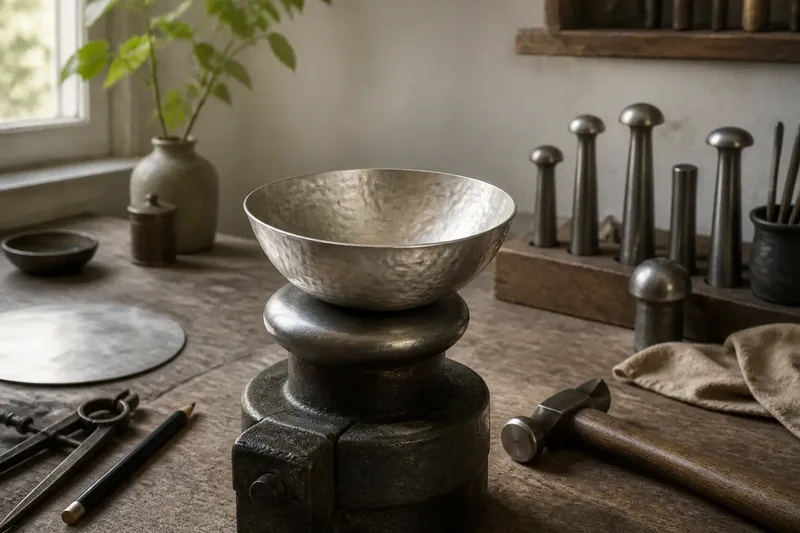
Raising silver turns a flat sheet into a hollow form through repeated hammer blows, and the marks left behind show how the metal travelled. A shallow bowl, for instance, begins as a disc whose edge is gradually drawn down and inward over a stake. The work moves through shaping, checking and annealing in a steady rhythm.
This process suits makers who want a continuous body rather than a form assembled from separate pieces. It also explains why a raised vessel may carry subtle changes across its surface. Those marks record contact between hammer, metal and support.
Raising draws the rim towards the centre
In raising, the maker works around the edge of a metal blank, using a hammer to move small areas of metal down and towards the centre. The blank rests on a stake, a shaped metal tool held securely in a stand or vice. As the rim descends, the sheet curves into a hollow.
The direction and spacing of the blows matter. A maker generally works in overlapping passes around the form rather than forcing one area into shape all at once. Each pass makes a modest change. Together, the passes build depth while helping the rim remain even.
Raising differs from sinking. In sinking, a blank is driven into a hollowed support, and the metal stretches to form a depression. Raising uses blows against a stake to bring the edge down around a form. The methods can be combined, but they leave different working patterns and need different support.
The blank needs room to move
Before shaping, the maker chooses a suitable sheet thickness and cuts a blank with enough material for the intended depth and rim. A disc that is too small may not provide enough metal to reach the desired profile. A much larger disc can leave excess material to manage around the edge.
Annealing softens work-hardened silver. Repeated blows make the sheet harder and less willing to move; if the maker continues without softening it, the metal may resist shaping or develop cracks. The work therefore alternates between controlled deformation and restoring some softness.
For silver, heating and cooling choices depend on the alloy and the maker’s equipment. Follow the metal supplier’s guidance and established workshop practice. If you are new to hot-metal work, learn with an experienced smith rather than improvising around heat or fumes.
A working session needs a clear aim
A useful session might aim to lower the wall, even out a section or refine the curve. The maker checks the blank for its centre, edge and irregularities from cutting. Then the metal is positioned on a stake that supports the area being worked, and the hammer is used in a steady sequence of light, overlapping blows.
After a pass, the maker turns the piece and checks its profile from the side. This pause can reveal a high spot, an uneven rim or a section that has moved further than its neighbours. The next pass can address that area instead of adding blows everywhere by habit.
When the metal becomes less responsive, the maker stops to anneal it according to the alloy and workshop method. Once it is ready to work again, the piece returns to the stake for another pass. The sequence continues until the depth and curve approach the intended form. If a crack appears or the edge folds sharply, stop and assess the cause rather than hammering harder.
Say you are shaping a small silver cup from a round blank and its right side sits lower than its left when viewed from the side. You mark the low area with a removable pencil line, then turn the cup so that the neighbouring high section is supported on a stake suited to the curve. With light, overlapping blows on that high section, you draw the profile towards the lower side; after each short pass, you turn the cup and check the outline again. If the right side rises towards an even curve, continue cautiously; if it drops further or a sharp crease appears, stop and reassess the support and working direction. The visible decision is whether the side outline has become more balanced without introducing a fold.
Hammer marks show contact and direction
Small facets, shallow arcs and overlapping impressions can remain after raising. Their shape depends on the hammer face, the stake, the angle of contact and the sequence of blows. A smooth-faced hammer may leave broad, subdued marks, while a more defined face can leave clearer impressions. The metal also reflects how firmly it was struck and how much later finishing removed.
Marks tend to follow the working path. A change in their direction may indicate that the maker turned the vessel, changed the support or adjusted the angle. Around a curve, the impressions can appear to wrap with the form. They are like footprints in soft ground: each records a contact, while the path suggests where the work went next.
Not every visible mark can be read with certainty. Later planishing, filing or polishing may soften earlier traces, and a maker may deliberately leave a textured finish. Look for patterns across the surface rather than treating one dent as proof of a particular tool or motion.
What should guide a change in approach?
How often should silver be annealed?
There is no fixed interval for every blank, alloy or amount of deformation. Judge by the metal’s response, stop when it becomes noticeably harder to move, and follow suitable workshop guidance.
What does an uneven rim tell you?
It may mean one part of the edge has moved further than another, or that the blank was not centred consistently on the support. Check the outline and side profile before the next pass, then direct the work towards the area that needs correction.
Can hammer marks remain on the finished surface?
Yes. Some makers leave an even, deliberate texture, while others planish or polish the piece more smoothly. The choice depends on the intended appearance and how clearly the maker wants the working marks to remain visible.
Why might a raised form crack?
Cracking can follow excessive deformation, uneven working, a flaw in the blank or metal that has become too hard to shape comfortably. Stop if a split begins, and ask an experienced smith to assess whether the piece can be repaired safely.
Finishing can soften the record of making
Once the form is established, the maker may use planishing: controlled blows intended to even the surface and refine the shape. A planishing hammer and a well-matched stake can reduce prominent raising marks without erasing every trace. Filing and polishing can remove more, though each changes the surface and its character.
Finishing also brings practical choices. A highly reflective surface makes small irregularities easier to see, while a textured finish can make the hammering the main visual feature. Consider the vessel’s intended use as well as its appearance: a rough rim or an interior that is difficult to clean may need attention even when the outer surface is meant to show its making.
For a learner, a useful record notes the supplied alloy, the stake and hammer used, where the profile changed, and when the metal needed softening. These observations make the next session more deliberate and help distinguish a mark left by shaping from one created during finishing.
Read the surface as a sequence of decisions
Raised silver makes the most sense when its shape and marks are considered together. The hollow profile shows how far the edge has travelled; the surface offers clues to the tools and working direction; the finish reveals how much of that record the maker chose to retain. No single mark tells the whole story, but a consistent pattern can make the sequence easier to imagine.
When looking at a raised vessel, start with the outline, then follow the marks around the body and notice where their direction changes. That simple reading turns hammer texture into useful evidence of making, while leaving room for what cannot be known from the surface alone.