A Closer Look at the Quiet Design of a Silver Spoon
Read a silver spoon by its bowl, handle and balance to understand the task its maker anticipated, without confusing visual clues with an appraisal.
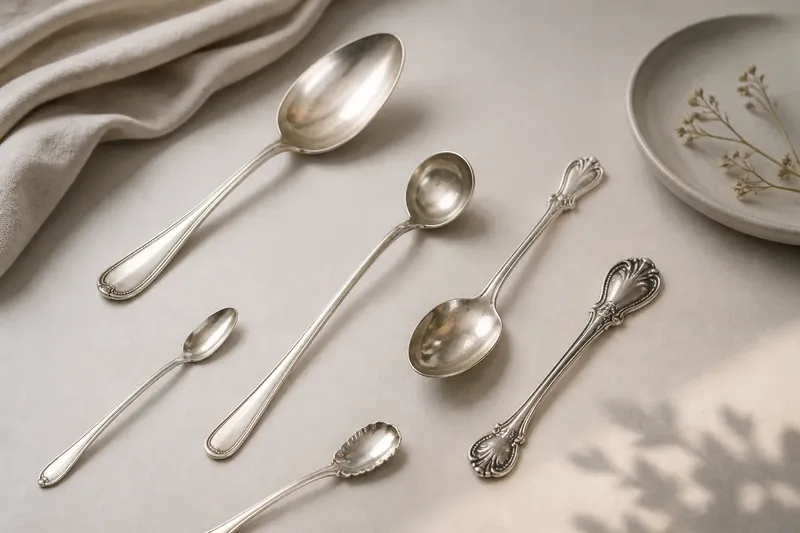
A silver spoon’s shape often tells you more about its intended task than its decoration does. To read the quiet design of a silver spoon, begin with the bowl, follow the handle, then consider how the two meet in your hand. That close look can suggest whether a piece was made for stirring, serving, tasting or another familiar action. It cannot, by itself, establish a spoon’s age, maker or monetary worth.
Think of the spoon as a small tool whose parts have to work together. A broad bowl paired with a short handle feels different from a narrow bowl on a long stem, just as a kitchen knife and a butter knife suit different jobs. The useful question is not “What is this worth?” but “What action does this form make comfortable?”
Start with the spoon’s overall proportions
Set the spoon on a plain surface under soft, even light. Look at it from above, then turn it sideways. Notice the total length, the bowl’s width in relation to that length, and whether the handle looks sturdy or delicate. Avoid deciding from one feature alone: a long handle may suit a serving spoon, but its bowl and shape should support that reading.
Next, imagine the spoon moving through an ordinary task. Would its bowl reach into a deep pot? Would the handle clear the rim of a cup? Could its end rest comfortably in a small dish? These are prompts for visual interpretation, not instructions to use a fragile or unfamiliar object. A spoon’s proportions may point towards a purpose, but they do not prove what it was originally called or used for.
Also look for a sense of visual continuity. A bowl that widens gradually into the neck often reads as one flowing form; a pronounced shoulder or abrupt change can make the junction look more formal or specialised. The transition gives you a clue about how the maker wanted the spoon to move and feel, even when ornament is sparse.
Read the bowl as a clue to the task
Begin with depth. A deeper bowl can hold a fuller mouthful or carry liquid, while a shallow one tends to spread its contents. Then look at the outline. A rounded oval, a narrow oval and a nearly circular bowl each suggest a different relationship with the food or vessel it might meet.
- Broad and shallow: this can suit lifting or serving portions that benefit from a wide surface, such as a soft side dish.
- Deep and rounded: this can suggest carrying liquid or a substantial spoonful, particularly when the handle is long enough to reach into a vessel.
- Narrow and elongated: this may fit a small cup, jar or dish where a broad bowl would be awkward.
- Small and shallow: this often reads as a tasting or condiment form, though size alone does not settle the intended use.
Check the rim and the bowl’s cross-section as well. A gently curved edge can make a spoon feel suited to scooping; a more pointed or tapered end may help reach into a narrow corner. A flattened bowl can sit differently against the tongue or a dish than a deeper one. These are modest distinctions, but together they give a better reading than a label based only on size.
Imagine you have found a silver spoon with a narrow, shallow bowl and a long, slender handle. The outline could make it useful for reaching into a small jar, while the elongated handle would keep fingers away from its contents. That is a plausible reading of its design, not evidence that it was made for a particular product or period.
Let the handle explain reach and grip
Follow the handle from the neck to its terminal end. A long stem increases reach; a short one keeps the hand close to the bowl. A broad, gently flattened handle may sit differently between the fingers from a round, narrow stem. Look for a curve or a slight change in width that might make one grip more natural than another.
Turn the spoon over. The underside can reveal whether the handle is flat, rounded, ridged or shaped to rest against a surface. A terminal that widens or curls may provide a visual counterweight to the bowl, or simply finish the design. It is useful to ask how the end might meet a hand or tabletop, but avoid treating any single flourish as a definitive functional sign.
Decoration also changes how the handle reads. A smooth, slim stem can appear practical and restrained; a heavier terminal or engraved panel can give the same spoon a more ceremonial presence. Ornament may make a handle easier to identify within a set, but it should not distract from its length, thickness and relationship to the bowl.
If a spoon has a strongly curved handle, notice the direction of the curve and how it aligns with the bowl. A bend can affect how the bowl approaches a cup or serving dish. It may also reflect a design convention rather than a special task, so treat it as one part of the overall picture.
Use balance as a reading, not a test
Balance is the relationship between the bowl’s apparent weight, the handle’s length and the point where the form seems to turn in the hand. You can assess it visually by comparing the thickness and width of both ends. If you handle the object, do so gently and only when appropriate; a fragile, loose or borrowed spoon is best left undisturbed.
A spoon that looks balanced may have a bowl and handle of similar visual weight, or a handle that gradually tapers to offset a broad bowl. A very long handle can make a small bowl seem more delicate; a substantial bowl may need a sturdier neck to look convincing. These impressions help explain why a design feels suited to a task, but they do not establish its original purpose.
Consider where the spoon might rest between actions. A shaped terminal, a slight bend or the angle of the bowl may make it sit neatly on a saucer or across a dish. Such details can be practical, decorative, or both. Read them alongside the bowl and handle rather than assigning them a single meaning.
Choose the reading that fits your situation
If you are looking at a spoon in a display case, focus on proportion and visible form. Compare bowl width, depth, handle length and the junction between them. Since you cannot assess how it sits in your hand, describe what you can see: “a deep oval bowl on a long, narrow handle” is more useful than a confident but unsupported name.
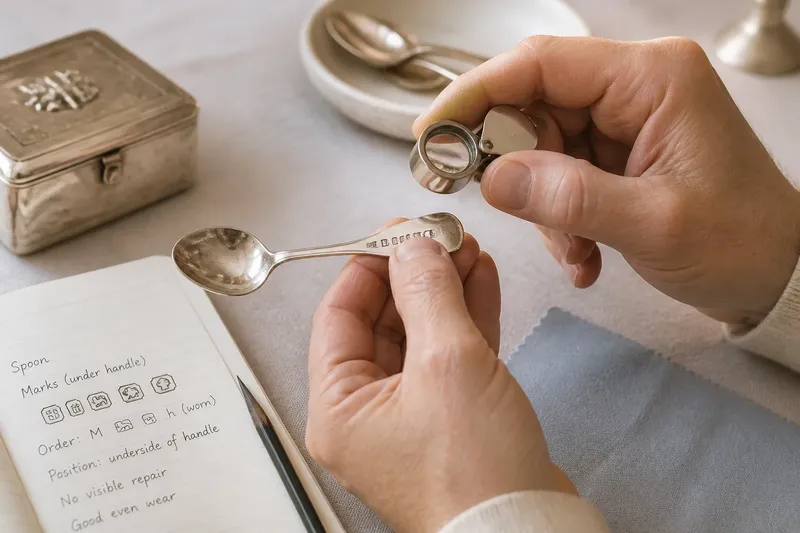
If you are sorting a family collection, begin by grouping spoons with similar bowl shapes and handle profiles. Keep a note of any marks or inscriptions separately from your design reading. That gives you a clear description of each object without turning resemblance into a claim about shared age, maker or value.
If you are choosing a spoon for display, decide what you want its form to communicate. A broad serving bowl may read clearly from across a cabinet; fine engraving or a delicate handle rewards a closer view. Use a stand that supports the spoon without pressing on a thin terminal or an already bent area.
If you are considering a spoon for actual use, first confirm that its condition and intended use are suitable. Old silverware can have loose joints, sharp edges, repairs or surface treatments that are not obvious from a photograph. Where safety or food contact is uncertain, ask a qualified conservator or another relevant professional rather than relying on appearance alone. Product labels, maker guidance and applicable local rules should determine any care or use decisions.
What can a spoon’s design tell you?
Can I identify a spoon’s original use from its shape?
Shape can suggest a likely task, especially when bowl, handle and overall proportions point in the same direction. It rarely identifies the original use with certainty, since designs can overlap and objects may later be used differently.
Does a long handle mean the spoon was made for serving?
A long handle offers reach, which can suit serving from a deep vessel, but it is not decisive on its own. Check whether the bowl’s size and form also make that interpretation plausible.
What should I note when describing a spoon?
Record the bowl’s outline and depth, the handle’s length and profile, and how the neck joins the bowl. Add visible decoration or marks as separate observations, rather than mixing what you see with what you infer.
Can design clues tell me what a silver spoon is worth?
No: a visual reading is not an appraisal. Value can depend on factors beyond form, so seek an appropriately qualified specialist if you need an assessment.
Keep observation separate from interpretation
A useful description has two parts. First state the visible details: “shallow oval bowl, narrow neck, long tapered handle”. Then offer a measured interpretation: “the proportions may suit reaching into a small vessel”. That distinction keeps your notes honest and makes it easy to revise your reading if another clue appears.
Hallmarks, inscriptions and construction details may add context, but they answer different questions from the spoon’s shape. A mark can be a clue to metal or maker; the bowl and handle describe a design relationship. Keep those lines of inquiry separate rather than asking the form to tell a complete history.
For a closer look at the quiet design of a silver spoon, return to the same three parts: bowl, handle and balance. Read each as a clue, then ask whether the whole form supports your interpretation. The most useful conclusion is often modest: not a grand claim about origin, but a clear account of what the spoon’s shape seems ready to do.