A Hallmark Is a Clue, Not a Complete Biography
A silver hallmark can clarify an object’s marks and limits. Learn how to record, compare and describe the evidence without claiming more than it supports.
A silver hallmark can help identify a metal standard, an assay office or a registered maker, but it cannot tell you an object’s whole story. Read the marks as evidence about the marking, then compare them with the object before drawing conclusions.
A silver hallmark supports specific claims
Depending on the place and period, a group of marks may indicate a fineness standard, an assay office, a maker or sponsor, and sometimes a date or duty. Their arrangement and style can matter as much as the symbols themselves.
Each mark has a limited role. A fineness mark concerns the alloy standard represented by that mark. An assay-office symbol can indicate where the item was assayed under a relevant system. A maker’s mark may connect the piece to a registered name or workshop. A date letter, where used, can help place the marking within a sequence.
These clues concern the object’s marking, not its complete history. A hallmark does not automatically identify the designer, the workshop responsible for every component, the original owner or the shop where the piece was sold. Marks may also be worn, incomplete, altered or separated from the context needed to interpret them.
Record the marks before interpreting them
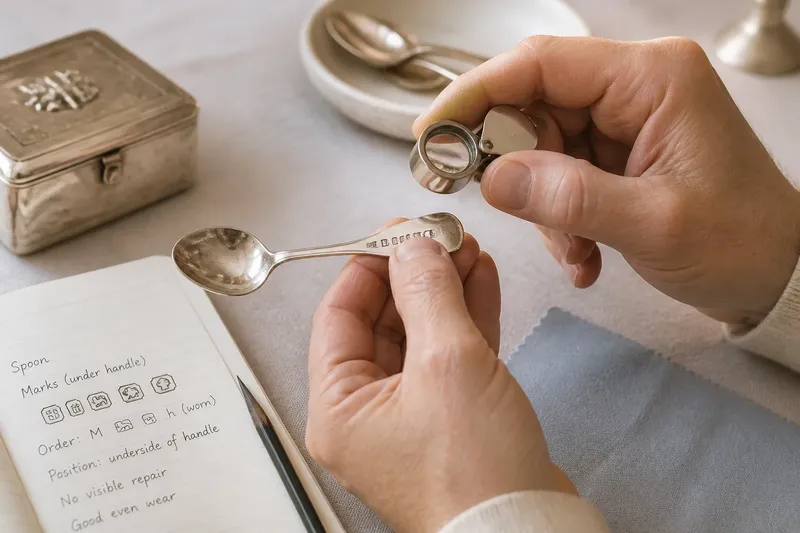
Use a magnifier and a bright, moveable light to inspect the marks from more than one angle. A phone photograph can help you compare shapes later, but glare, dirt and worn edges can make a symbol look different from what it is.
Write down the marks’ order and position. Note whether they are grouped together, whether one sits apart, and whether a handle, hinge or repair obscures any part. Avoid scraping or cleaning a mark to make it clearer; that can remove evidence or damage the surface.
Then compare the marks with the object’s construction, joins, decoration, wear and signs of repair. A hallmark is more persuasive when its apparent date and origin fit the object’s form and making. If the clues conflict, record the mismatch rather than forcing a tidy account.
Say you find a small silver box with a readable maker’s mark, a faint date letter and a hinge that appears to be a replacement. Record those observations separately. A reference may support a likely reading of the maker’s mark, while the worn letter leaves the date uncertain; the replacement hinge means the whole box should not be assigned one simple history. The resulting description might say that the box bears a mark associated with a registered name, while its date and hinge history remain uncertain.
Choose an identification method for your purpose
Match the effort and certainty of your identification to the decision you need to make.
- Record visible evidence: Check whether the marks are clear enough to describe and whether you can note their location. If you can, make a plain inventory description; if not, photograph the area without altering it and record that the marks are unreadable.
- Compare with a reference: Check whether a reputable hallmark reference covers the relevant place and marking system. If the symbols and context align, record a provisional reading; if they do not, retain the observation without assigning an origin.
- Ask a specialist: Check whether the result will affect a significant purchase, insurance decision or disputed attribution. If it will, seek an opinion from an experienced silver specialist, auction-house valuer or relevant assay-office resource; if it will not, a clearly qualified provisional description may be enough.
- Check the object’s construction: Look for joins, repairs, replacement fittings and differences in wear. If the marks and construction seem consistent, describe that agreement as supporting context; if they conflict, note the conflict and avoid dating or attributing the entire object from one mark.
- Keep a record: Check that your notes distinguish visible marks from your interpretation. If they do, retain them with clear photographs; if they mix observation and inference, rewrite them as separate statements before sharing or relying on them.
- Review the wording: Check whether your description claims a precise maker, date or original configuration. If the evidence supports that specific claim, state the basis; if it does not, use qualified wording such as “appears to” or “possibly” and state what remains uncertain.
Imagine you are cataloguing a small spoon for a family inventory. The inputs are a clear group of marks beneath the handle, a worn date letter and no visible repair. First, photograph the marks under angled light and write down their order and position. Next, compare the group with a reference that covers the relevant marking system; suppose it supports a likely maker’s mark but leaves two possible readings for the letter. Then check the spoon’s joins and wear, recording that you see no obvious repair rather than treating that absence as proof of an unchanged object. The resulting entry can identify the likely maker’s mark, describe the date letter as uncertain and leave the precise date open. If the inventory later becomes part of a sale or valuation, the uncertainty tells you when a specialist opinion may be worth seeking.
Choose the least elaborate method that answers your question. For a cupboard label, a careful description may be enough. If a mark will affect a sale or formal valuation, a reference-book match alone is a weak basis for a firm claim. Keep photographs and notes whichever route you take.
What can a silver hallmark tell you?
Does a hallmark prove who made the whole object?
Not necessarily. A maker’s or sponsor’s mark can identify the registered party associated with the marking, but another workshop may have made some or all of the piece. Repairs and replacement parts can complicate the link further.
Can a hallmark tell you exactly when an object was made?
Sometimes a date mark narrows the marking to a particular year or sequence, depending on the system and how clearly the symbol can be read. It does not, by itself, establish when the object was designed, assembled, sold or later altered.
Does a hallmark show where an object was sold?
Usually, marks are better evidence of a marking or assay context than of the shop where a buyer encountered the piece. Retail labels, inscriptions or documentary records may add clues, but each needs its own assessment.
What if a mark does not match the object’s appearance?
Record the mismatch instead of choosing whichever clue feels more convincing. The mark may be misread, the object may have been repaired or assembled from parts, or the reference may not cover the marking system; a specialist can help assess the competing explanations.
Describe uncertainty without becoming vague
Separate what you see from what you infer. “Three marks beneath the base, including a worn letter” is an observation. “Possibly assayed in a particular centre” is an interpretation. Keeping them apart lets another reader revisit the evidence without inheriting your conclusion as fact.
Use calibrated language such as “marked”, “appears to”, “possibly” and “consistent with”. Avoid claiming a famous maker, precise date or original configuration unless the full evidence supports that specific claim. If your reading depends on a particular marking system, use a reference for that system and state the uncertainty plainly.
A silver hallmark is a useful clue when you ask it a precise question. Record what is visible, compare it with the object and describe what remains uncertain; that gives the next reader a sound basis for their own judgement.